

Align
You’ve taken a significant step in securing your future and the future of your loved ones. Now, it’s time to align your beneficiary designations and asset ownership with your estate plan.


Update beneficiaries
Beneficiary designations supersede wills and trusts. Thus, ensuring that beneficiaries of life insurance policies, retirement accounts, annuities, and other accounts match your plan and wishes is critical.
If property is to be transferred to a trust at your passing, contact each institution and confirm its preferred method and verbiage for designating the specific type of trust that is included in your estate plan. For benefits through your employer, check with your HR department first.
Important: A trust should only be designated as beneficiary of 401Ks, IRAs, and similar retirement accounts for good reason and if the trust includes special tax provisions.
Update asset ownership
Update the ownership of bank accounts, taxable brokerage accounts, tangible personal effects, vehicles, closely-held business interests, and out-of-state real property to match your plan and wishes, if necessary.
Share
Share your arrangements with loved ones and decision-makers to ensure a comfortable level of access to and knowledge about your estate plan.

Secure your original documents
Keep originals in a secure and accessible place such as an at-home safe or fireproof folder. Avoid storing in a safe deposit box. Advise all decision-makers and loved ones on how to retrieve the originals in case of emergency. Generally speaking, there is no filing requirement during your lifetime.
Additionally, save our email with your signed copies attached so you can access your Health Care Power of Attorney and HIPAA Waiver in a medical emergency. Plus, upload copies of your medical directives to your primary physician’s office and preferred hospital system through MyChart.
Share copies with loved ones
To the extent you feel comfortable doing so, share copies of your documents with your loved ones and the parties who are named to serve in some capacity. We will also retain copies in our file. Make a list of everyone who receives a copy. If you ever change your documents, you will have a list of where to send updates.
Discuss roles and responsibilities with your decision-makers
Discuss the roles and accompanying responsibilities with each decision-maker you named. Let them know what they’ll need to do in case of incapacity or death and who will be responsible for handling specific tasks. If appropriate, consider holding a family meeting to discuss the choices you made and why you made them.
Begin to prepare your beneficiaries for the property you are leaving them. Or, if you prefer otherwise, no specific financial information needs to be disclosed. Introduce them to your advisory team so they know who to call when the time comes. The better prepared they are, the smoother the transition of property to them at your passing.
Compose
Compose several informal documents to record important details for your decision-makers to reference when a need arises. Be clear and concise, and add anything that you believe is important and would help things run smoothly.
Key Contacts
List names, contact info, and roles or titles for all decision-makers who are named in your estate plan. List your advisors such as our firm (as your estate attorneys), accountant, financial planner, insurance advisor, and banker. Also list doctors.
Download a Template
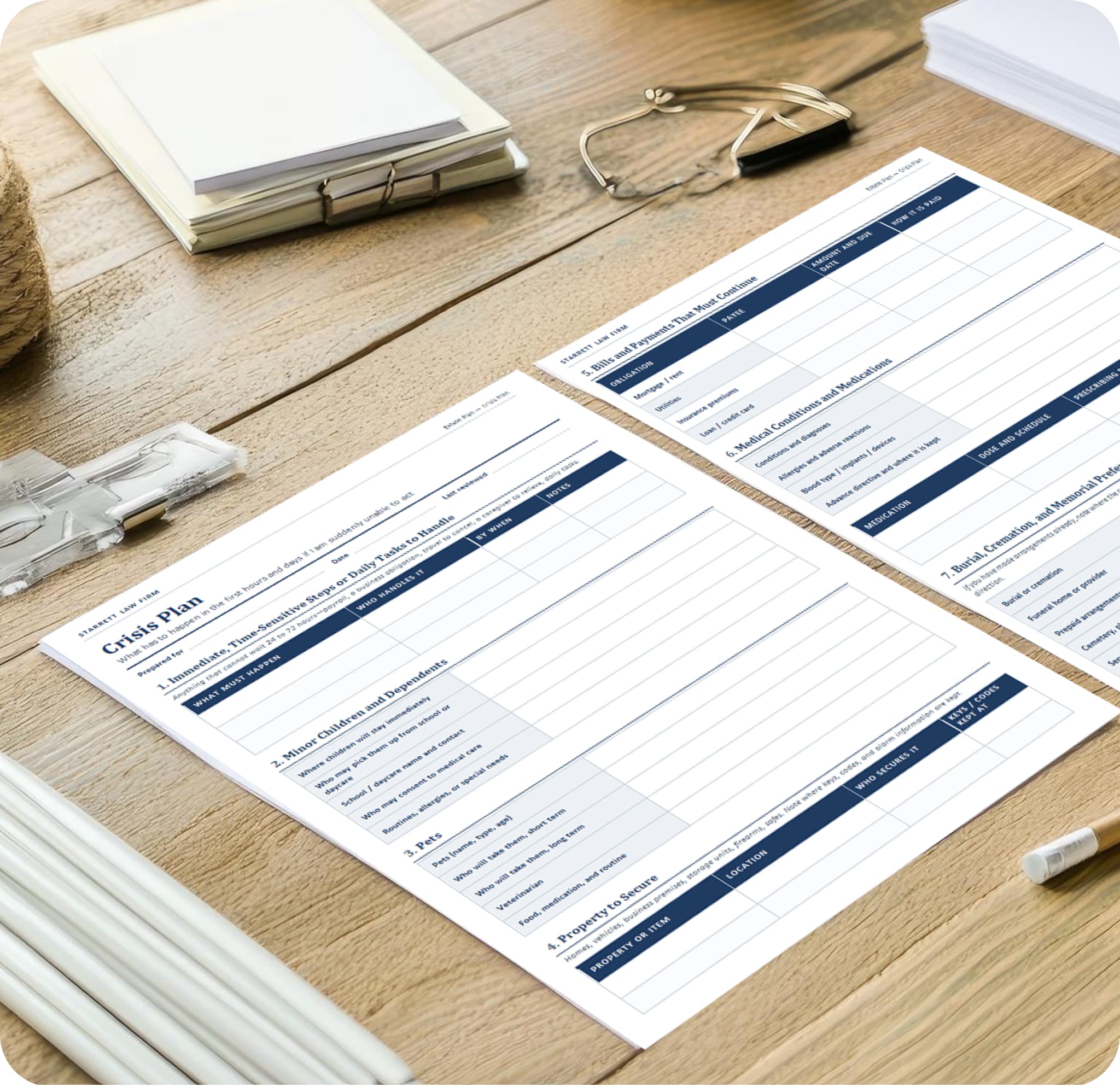
Crisis Plan
Note any time-sensitive steps or matters to be considered in case of emergency. Where will minor children stay? Who will look after pets? What property should be secured? What bills must be paid? List out daily tasks that you handle. Also include medical conditions, medications, burial/cremation preferences, and funeral/memorial plans, if any.
Download a Template
Estate Map
Keep an updated list of all of your assets, liabilities, social media and other online accounts, and insurance. Don’t overlook home maintenance details (water, gas, power, lawn care, etc.), email, photo and music storage sites, websites, and blogs. Include passwords for all of the above plus laptops and digital devices. Consider using an online password manager such as 1Password which is our personal favorite.
Download a Template
Letter of Intent
If your estate plan includes a discretionary trust to benefit children or other loved ones, write a Letter of Intent to guide your trustee in exercising discretion when managing the trust property. Tailor it to fit your circumstances and wishes.
Download a Template
Legacy Statement
Write/record a Legacy Statement to share priceless life lessons with your children or other loved ones. Potential themes can include love, family, hard work, faith, education, or some or all of the above. Leave instructions for its release, like dates or milestones (wedding, college graduation, etc).
Download a TemplateMaintain
Maintain your plan so it stays up-to-date as changes occur in your life.

Towards the end of each year, consider whether there have been changes in your circumstances that might impact your plan.
Our Estate Readiness Quiz will help prompt further reflection and indicate when updates are needed.
Share Your Experience
We’d love to hear your story. Share your experience with us and inspire others!
